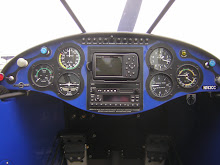
Yesterday afternoon I met with my DPE and finished the oral exam section of the two part private pilot checkride. Being the over achieving worrywart that I am, I went to the airport 2 hours early to ensure everything was prepared and readily accessible for the DPE. On my way in the DPE was leaving to grab some lunch. She asked why I was so early and if I would want to bump it up an hour; for whatever reason I agreed. It took a couple of seconds for me to realize that my preparation time had just been cut in half. This turned out to be a fantastic decision even though my apprehension level doubled because I lost an hour of preparation.
Hastily, I laid out all of the maintenance log books, my flight logbook, sectional chart and flight plan so that I might estalish a decent first impression. When the DPE arrived, we immediately finished the IACRA application and began examining the log books. Everything went smooth barring a little disappointment with some sloppy entries into my log book. She then asked if I was seeking aviation as a profession, and suggested cleaning up the logs if I were. That said we moved on to the flight plan and began discussing my planned route from HKY to FAY. After a few questions her phone rang and she proceeded to talk for a good 5-10 minutes. This was no skin off my back; in fact it was a welcomed break for me to collect my thoughts. After her conversation was through she proceeded to ask me a few questions about airspace and my privileges and responsibilities as a VFR pilot.
During all of the questioning the DPE did a fantastic job of carrying on a conversation (with me) while making sure I had some knowledge about aviation. We talked a lot about some of the trips she made and was able to somehow incorporate aviation into all of the stories she told. One such story involved a trip to Alaska where she had the opportunity to fly around Mt. Denali in a Piper Seneca. During their climb out she watched the altimeter and the pilot to see when he would offer everyone oxygen. She stopped the story there and asked what aeromedical factor might be experienced at these altitudes. It was simple stories like these that made the exam comfortable and fun. Unfortunately, I worried way too much and could have gotten away with a lot less studying. Better safe than sorry, though.
I guess everything went well, because she didn't tell me I failed. I was supposed to take the practical today at 12pm, but it was slightly windy and very hot. When I got to the airport I asked myself, 'if it were any other day, would I fly by myself?' I answered no and decided to postpone the flight until tomorrow morning at 7:30. Hopefully by noon tomorrow I will be a private pilot!
Saturday, June 27, 2009

Tuesday, June 16, 2009
Indefinate Checkride Date
Since my previous post, little development has occurred and I disappointedly remain a student pilot. My disappointment doesn't come from being a student; rather, it is an artifact of not completing the requirements necessary to obtain my private pilot's certificate in time for an upcoming family visit. Normally my disappointment and anxiety would be less evident, but since my family rarely visits western NC, this weekend would be one of the few chances I could have taken my father flying. Not to mention, this is Father's day weekend.
At this time I do not have a firm date to anticipate, but I continue to study and mentally prepare for the oral and practical exams. I am hoping to take the checkride within the next week if the weather holds. The more it draws out the less confident and more nervous I get. I trust that these delays are happening for a reason. Who knows, maybe a gust of wind would have resulted in a failure on a day the checkride had been scheduled to occur.
During this delay, I developed a nifty weight and balance spread sheet that calculates the weight and C.G. information, and confirms safe flight using conditional formatting and graphics. The image below compares two situations differing only in the amount of fuel on board. As you can see, when too much fuel is added a red warning message appears in conjunction with the graphic showing a plotted point outside the W&B limitations. I hope to soon develop another calculator that will use the landing and take-off charts to determine the respective distances needed for each to occur safely. This will be a little more difficult and less accurate due to the interpolations that will have to be made using proprietary equations established by Cubcrafters.

At this time I do not have a firm date to anticipate, but I continue to study and mentally prepare for the oral and practical exams. I am hoping to take the checkride within the next week if the weather holds. The more it draws out the less confident and more nervous I get. I trust that these delays are happening for a reason. Who knows, maybe a gust of wind would have resulted in a failure on a day the checkride had been scheduled to occur.
During this delay, I developed a nifty weight and balance spread sheet that calculates the weight and C.G. information, and confirms safe flight using conditional formatting and graphics. The image below compares two situations differing only in the amount of fuel on board. As you can see, when too much fuel is added a red warning message appears in conjunction with the graphic showing a plotted point outside the W&B limitations. I hope to soon develop another calculator that will use the landing and take-off charts to determine the respective distances needed for each to occur safely. This will be a little more difficult and less accurate due to the interpolations that will have to be made using proprietary equations established by Cubcrafters.

More to come...stay tuned
Wednesday, June 10, 2009
Saturday June 13, 2009- Checkride
As of today, the current forecast for Saturday is 85 F and partly cloudy. There has been a high pressure system in the Gulf of Mexico for the past several days which looks to be keeping much of the adverse "spring-time" weather to the north of western NC. My checkride is scheduled for Saturday morning hours in hopes that the turbulence will be less, and I can better focus on the practical test standards. As for the oral exam, this will be conducted the preceding afternoon. Apparently my instructor has another student who is receiving sea-plane training and needs a check-ride as well. Killing two birds with one stone, I suppose. With the testing broken up like this my nerves will be a little less for each examination. However, my instructor informed me that the FAA will be present during the oral part of the exam to conduct their own review of the examiner who has not examined in quite some time. Not again... The same thing happened to me as I was solo'ing for the first time at KMRN. While I was there, another gentleman was being reviewed after an incident involving a cub whose throttle was fire-walled while being hand-propped. Hopefully, like last time everything will go smoothly and the FAA nor my examiner will have much to say.
The studying has reached point of monotony and my flight plan is ready to be made. My nerves are gathering and my brain is overflowing. I can't wait to get this over with so I can share my passion with friends and family!
Check out this intersting video:
http://www.youtube.com/watch?v=9ZBcapxGHjE&feature=rec-HM-fresh+div
The studying has reached point of monotony and my flight plan is ready to be made. My nerves are gathering and my brain is overflowing. I can't wait to get this over with so I can share my passion with friends and family!
Check out this intersting video:
http://www.youtube.com/watch?v=9ZBcapxGHjE&feature=rec-HM-fresh+div
Monday, June 1, 2009
An Eventful Checkride Practice
As the time for my checkride draws nearer, my anxiety level continues to increase. Prior to this Saturday morning my confidence level was close to five on a scale of one-to-ten. Although the practice revealed areas I needed to improve, my confidence level increased enough to counteract my fear of failure and compose my state of mind. The flight began with a smooth take-off and continued as such until my instructor asked me to report my first checkpoint on our way to Shelby County Airport. All of my previous cross country trips were very organized and uneventful. However, on this practice run, I found myself scrambling to determine where we were. This came as a result of not having fully been able to prepare my flight plan before departure. Luckily this was practice (which I am told makes perfect). After determining our location I practiced some steep turns, slow flight and stalls. The power off stall were uneventful, but power on stalls were a little more exciting. After slowing the plane to 50mph and dropping the RPM to 1500, I applied full throttle and entered a climbing right turn. During the middle of the turn I became too focused outside and neglected the turn coordinator. Once the airplane was stalled the left wing dropped and we entered the incipient phase of a spin. In my minds eye I saw the acronym P.A.R.E.. As I attempted to bank right to get us out of the spin I realized the ailerons were not responding. At this point I remembered "opposite rudder" (the "R" in P.A.R.E.) and heard my instructor saw opposite rudder. Wow! I nearly soiled myself. As we left the incipient phase, I inched the nose up, released opposite rudder and applied throttle to regain straight and level flight. What a great relief and learning experience this was. I am grateful to have had been instructed well enough to realize what I was supposed to do. I strongly recommend training for spins so that you may realize what it feels like to enter one.
After all of the aerial maneuvers, it was time to hone my landing skills. We practice short and soft-field landings. My first shortfield landing was a little rough and would not have passed, but the second one was considered passing. After a few more touch-and-go's I was introduced to wheel landings for the first time. For this type of landing the approach is made at 70 mph compared to the normal approach speed of 55 mph. The plane it held above the runway significantly longer as you gingerly move the controls to slowly fly the plane to the runway. Once the wheels have kissed the runway, power is fully reduced and brakes are slowly applied. Once slowed down the stick is brought back to lower the tail and gain better steering. After a few tries I began to get a hold of the technique and was able to execute an acceptable wheel landing. After this, my instructor demonstrated a poor wheeling landing wherein he threw the stick forward to imitate a pilot who might be impatient and wants to get on the ground sooner than he should. I will be uploading a nice video of this demo sometime tonight.
With this 1.5hrs of practice I was able to see what needs to be improved. Although my confidence level did not increase too much, I was able to realize what needs to be improved so that I am not surprised when it comes time to take the checkride. Look for videos of practiced landings within the next two weeks!
After all of the aerial maneuvers, it was time to hone my landing skills. We practice short and soft-field landings. My first shortfield landing was a little rough and would not have passed, but the second one was considered passing. After a few more touch-and-go's I was introduced to wheel landings for the first time. For this type of landing the approach is made at 70 mph compared to the normal approach speed of 55 mph. The plane it held above the runway significantly longer as you gingerly move the controls to slowly fly the plane to the runway. Once the wheels have kissed the runway, power is fully reduced and brakes are slowly applied. Once slowed down the stick is brought back to lower the tail and gain better steering. After a few tries I began to get a hold of the technique and was able to execute an acceptable wheel landing. After this, my instructor demonstrated a poor wheeling landing wherein he threw the stick forward to imitate a pilot who might be impatient and wants to get on the ground sooner than he should. I will be uploading a nice video of this demo sometime tonight.
With this 1.5hrs of practice I was able to see what needs to be improved. Although my confidence level did not increase too much, I was able to realize what needs to be improved so that I am not surprised when it comes time to take the checkride. Look for videos of practiced landings within the next two weeks!
Wednesday, May 13, 2009
Landing at Clyde Valley Airport
Sorry for the vibration and low quality. Most of the work was performed by my instructor as it was a very tight squeeze into the field.
Feeling discouraged
Having finished the requirements necessary for the FAA to administer a check ride for my private pilot certification, my feelings are ambivalent. In one respect, I am thankful to have successfully reached 40 hours. Yet when I stop to think about how much I have learned, and the remaining check ride, I begin to feel discouraged.
There are two parts to the check ride. The first part consists of an oral exam wherein the examiner will test my general aviation knowledge. These are the types of tests I am accustomed to after spending 3 trying years in graduate school. On the other hand, I am not so confident with the practical part of the test, especially after today's flight.
Although my performance under the hood went well, even in rather turbulent flight over some hilly terrain, I thought I would be able to land on my own at Clyde Valley. Not being able to do so made me question my own abilities as a pilot. Granted the airstrip is tiny and holds some interesting terrain to negotiate, I felt I should have been able to get us on the ground without any assistance from my instructor.
I believe the major impetus for my discouragement arises from a discomfort with forwards slips to landing. With many accidents resulting from an overshoot of the base turn to final, I find myself concentrating on maintaining shallow COORDINATED turns as I come in to land; not deliberately uncoordinating my turns as is performed in a slip.
As we returned from Clyde Valley Airport to Hickory I called tower 9 miles out and gave the typical position report and requested a full-stop landing. Tower came back and told me to report mid-field, right downwind for 19. I responded with a request for 24 in order to obtain some crosswind landing experience. Tower accepted my request and I removed the foggles 1.5 miles from the airport and called my mid-field downwind for 24. Abeam the numbers, my instructor asked what flap setting I would use for this landing. Due to the slight breeze I said that one notch would be fine. After saying so he pulled the throttle and said, "engine failure". I ran though my ABCs. (A) Airspeed for best glide, (B) best place to land, hickory airport and (C) checklist. Keeping an eye on the runway I made my base turn such that I would be a little high on final.
I had already mentally prepared myself for a forward slip to landing while day dreaming at work. In this dream we were on final to land; not on base-to-final as we were yesterday. As I turned from a right-base to final my instructor told me to slip. Two things immediately came to my mind. One, we have never performed a slip from base to final while trying to turn, and two an uncoordinated turn from base to final is rather dangerous if airspeed is not maintained above the stalling speed of the aircraft. At this point, I was fighting to keep my left foot on the left rudder pedal, and not on the right pedal. We were now trying to maintain a turn mid-slip. My mind was working and telling my what to do, but muscle memory governed my intellect.
After working the controls with my instructor through the slip, I landed the plane using an uneventful side-slip to counter the southerly crosswind. After exiting the plane, many what-ifs began to arise in my mind. What if the examiner asks me to do this of that, will I be prepared enough to successfully accommodate their request? I hope so, but until then I will continue to practice and study the oral exam guide.
Now, my mental preparation will be focused on a new aspect of forwards slips, and will consider the other aspects of flight where I can utilize the forward slip. With the majority of slip training encompassing slips using left aileron and right rudder, (due to the ease of pushing the stick left, if you are right handed) I had limited my scope to straight flight. I will now be more open to using this slip and its counter part to lose altitude in turns before turning final.
As I have learned, the skills that we acquire may not be limited to one responsibility. I encourage anyone learning to fly to think about all of their skill sets and how they maybe used outside of the box. However, I do not encourage anyone to try anything without first talking to their flight instructor.
There are two parts to the check ride. The first part consists of an oral exam wherein the examiner will test my general aviation knowledge. These are the types of tests I am accustomed to after spending 3 trying years in graduate school. On the other hand, I am not so confident with the practical part of the test, especially after today's flight.
Although my performance under the hood went well, even in rather turbulent flight over some hilly terrain, I thought I would be able to land on my own at Clyde Valley. Not being able to do so made me question my own abilities as a pilot. Granted the airstrip is tiny and holds some interesting terrain to negotiate, I felt I should have been able to get us on the ground without any assistance from my instructor.
I believe the major impetus for my discouragement arises from a discomfort with forwards slips to landing. With many accidents resulting from an overshoot of the base turn to final, I find myself concentrating on maintaining shallow COORDINATED turns as I come in to land; not deliberately uncoordinating my turns as is performed in a slip.
As we returned from Clyde Valley Airport to Hickory I called tower 9 miles out and gave the typical position report and requested a full-stop landing. Tower came back and told me to report mid-field, right downwind for 19. I responded with a request for 24 in order to obtain some crosswind landing experience. Tower accepted my request and I removed the foggles 1.5 miles from the airport and called my mid-field downwind for 24. Abeam the numbers, my instructor asked what flap setting I would use for this landing. Due to the slight breeze I said that one notch would be fine. After saying so he pulled the throttle and said, "engine failure". I ran though my ABCs. (A) Airspeed for best glide, (B) best place to land, hickory airport and (C) checklist. Keeping an eye on the runway I made my base turn such that I would be a little high on final.
I had already mentally prepared myself for a forward slip to landing while day dreaming at work. In this dream we were on final to land; not on base-to-final as we were yesterday. As I turned from a right-base to final my instructor told me to slip. Two things immediately came to my mind. One, we have never performed a slip from base to final while trying to turn, and two an uncoordinated turn from base to final is rather dangerous if airspeed is not maintained above the stalling speed of the aircraft. At this point, I was fighting to keep my left foot on the left rudder pedal, and not on the right pedal. We were now trying to maintain a turn mid-slip. My mind was working and telling my what to do, but muscle memory governed my intellect.
After working the controls with my instructor through the slip, I landed the plane using an uneventful side-slip to counter the southerly crosswind. After exiting the plane, many what-ifs began to arise in my mind. What if the examiner asks me to do this of that, will I be prepared enough to successfully accommodate their request? I hope so, but until then I will continue to practice and study the oral exam guide.
Now, my mental preparation will be focused on a new aspect of forwards slips, and will consider the other aspects of flight where I can utilize the forward slip. With the majority of slip training encompassing slips using left aileron and right rudder, (due to the ease of pushing the stick left, if you are right handed) I had limited my scope to straight flight. I will now be more open to using this slip and its counter part to lose altitude in turns before turning final.
As I have learned, the skills that we acquire may not be limited to one responsibility. I encourage anyone learning to fly to think about all of their skill sets and how they maybe used outside of the box. However, I do not encourage anyone to try anything without first talking to their flight instructor.
Sunday, May 10, 2009
The last 0.8hr of training

Sometime this week I hope to finish the remaining 0.8 hours of my private pilot training. During this time, I will be working under the hood and hopefully flying over to 3NC0 http://www.airnav.com/airport/3NC0. This is a tiny field located about 1 mile from my in-laws house in Morganton, NC. Flying into 3NC0 will provide another opportunity to practice short field landings and take-offs; with the added challenge of negotiating substantial terrain. At the end of runway 34 are powerlines while the opposite end is fenced in by a small hill topped with 50' trees. It seems that the only way around the trees is through a small pass to the right of the end of the runway. Stay tuned for updates about this flight...I have yet to receive full approval from my instructor. I have attached an image highlighting what I believe to be the departure route from runway 16.
Subscribe to:
Posts (Atom)

 Posts
Posts